Showing posts with label Soweto township. Show all posts

Friday, March 18, 2011

Photo Walk in Kliptown

Last weekend I went on my first Photo Walk. The destinations of these walks are different each time and you walk with a group of photographers. This time it was Kliptown, the poorest side of Soweto township.

First stop on our trip was the Freedom Charter and the Walter Sisulu Square. In 1955 the Congress of the People, who met here to draw up the Freedom Charter, an alternative vision to the repressive policies of the apartheid state.

(Just click on any of the pictures for a bigger size)


After that we went to Kliptown and stopped by the KYP, Kliptown Youth Program. KYP's mission is to eradicate poverty of mind, body, and soul and to fight against the disadvantages imposed on the children of Kliptown, by providing educational support and positive activities to engage in after school.


In the street where the center was, all the women where outside, I guess the weekend is saved for washing, since all the women were doing their laundry and hanging their clothes over the fence...


I was mesmerized by all the children at KYP, look at these faces!! Meeting these precious faces... these cute little girls, who brake my heart. To see them living in these poor conditions, but such a smile on their faces, or sometimes these very serious faces... already opposed to such dire circumstances... and you know it will not get much better... Being a girl living here, chances that you will get raped is higher than going to school!!


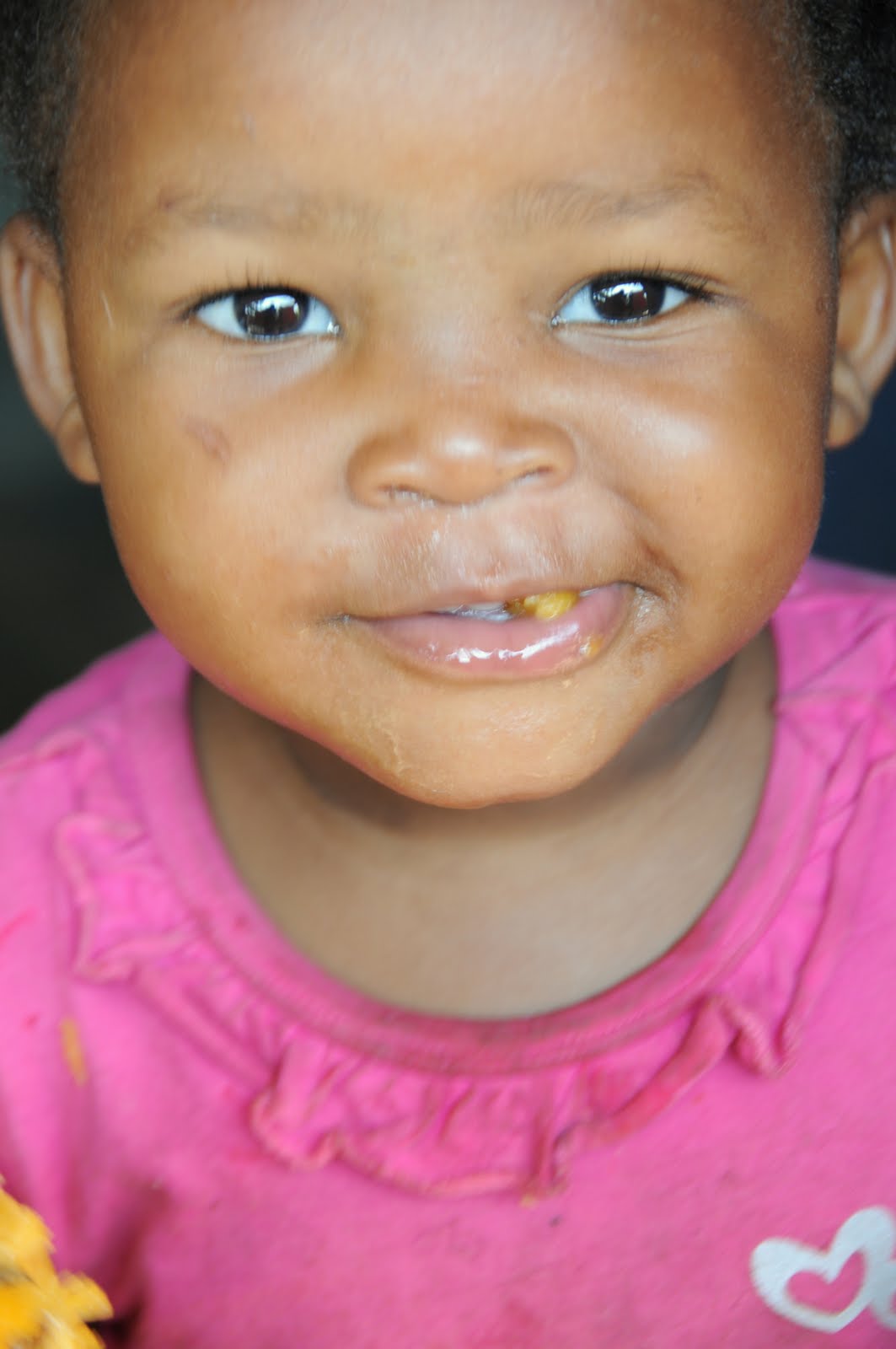


KYP seeks to develop young and dynamic individuals who are willing to contribute effectively for the betterment of their communities. KYP’s tutoring, athletic, and arts programs provide a life to the children of Kliptown defined not by survival, but instead by the ability to be active community members, to have dreams, and most of all to create hope about the future. You can find them on FaceBook as well. Become a friend and help with donations, these kids deserve it!!

So this trip was on a Sunday and normally the center is closed and the kids are off but for us they came to welcome us and to tell us a bit about their lives. A friend of mine, Karen had talked about KYP on her blog before and got so many donations in Singapore that she was bringing that day. She even got a brand new computer from a reader of her blog. She went to Singapore to collect all the donations and last Sunday we went with the Jozi Photowalkers to give all these donations.


You should have seen the faces of these children, it humbles you!! These kids have almost nothing, but NO begging or asking for things, so well raised. And when we gave them some sweets their faces lit up, but even without the sweets, just us being there made those kids day! We took lots of photographs and I can't show you all, but go to my FB account and see more if you like.

Thulani Madondo KYP's leader showed us around at the center and around Soweto half of the day. A trip like this you won't find anywhere else! We visited people's homes, we talked to residents of Kliptown and other parts of Soweto. It was a day to never forget!

The boys did a gumboot dance for us, but I didn't take a video, so I used one from Youtube, but they are the same boys in the same classroom. The gumboot dance originates from the railroad workers during the gold diggers time in Africa. This was a dance to communicate between each other and also to get some relaxation from the hardship of working all day in the blaring sun, digging and working on the tracks.


Here they are all posing for us after the dance! Such a fun bunch of kids!!


It hits hard when you visit these townships, and you see these innocent cute little faces. I want to help more, do you want to help me help them?? Please contact the KYP and donate, so these precious little children have a chance for an education.

See what your money can do here!! ~ WHAT YOUR RAND or $ CAN BUY FOR KYP (to make it easy: from R to $, just take off 0)
So R100 is about $10 ~ give and take...

From R0 to R100
R30: Whistle
R40: Dancing sneakers
R65: Netball sneakers
R70: Netball ball
R80: Gumboots

From R100 to R1000
R100: One hour of tutoring by a professional tutor
R130: Soccer ball
R170: School fees
R250: Soccer boots
R450: Internet for one month
R500: Electricity for one moth
R500: Full school uniform for one child
R800: Jembe drums used for dancers

More than R1000
R1500: Fabric for traditional dancers
R15,000: College student for one year
R12,000: Travel to dance auditions for entire company
And most important of all....
School fees: R50-R700

All donations are much appreciated by KYP and no donation is small!
For more information you can email Thulani Madondo at kliptownyouthprogram@gmail.com

The longer I am here in SA, the more I discover of this beautiful country and the more I appreciate to see all the different areas, the rich and poor side... and you know what these kind of areas are so much more interesting, the stories are amazing!!
The people are fun, friendly and so welcoming!! Go and see them, they will open the doors for you!

Have a Fantastic Friday!
I am off tomorrow morning to INDIA!! (I am not sure if I can update my blog this coming week)

Ciao, Mireille

Monday, January 12, 2009

Soweto tour

We visited Soweto, the biggest black township in South Africa. It strethes out over more than 130 square kilometres southwest of the city of Joburg. Soweto is a combination of 21 townships, each with their own history and population. Soweto was proclaimed in 1904, and intended to house the black workers in the Johannesburg gold mines west of the city.
In the 1930s when the economic situation was bad and unemployment high, thousands of rural black set for Johannesburg trying to find a job. Orlando, one of the first townships, changed rapidly into a squatter region with the erection of corrugated iron huts on any piece of vacant land. For years local government could and would not meet the needs of those people.
Throughout the 1940s more and more people streamed up to this ‘native location’ south-west of the city. Situation even got worse when the Nationalist apartheid government in the 1950s started to re-locate black people by force from Sophiatown and other places within Johannesburg to Soweto. New suburbs as Meadowlands, Dobsonville, Kliptown and Pimville were born.
Life in Soweto was tough, pollution was high, mainly because most of the township lived without electricity and people had to rely on coal until the mid 1980s.
Services were limited and over-crowding immense. On average of 15-20 people were living in a single four-roomed matchbox house.


A painting on the side of the street of an old lady.

Kids heard we had candy, so they were more than willing to pose for us ;-)

Inside a corrugated shack where a family of 7 lives, mom, dad and 5 children!

A boy in front of his house.

No running water or electricity in these homes, this was the only waterpump for 1 whole street!

Day care centre.
The difference between rich and poor is very obvious and in your face in South Africa. These townships are hard to believe. That people still live in those conditions. Makes you sad and wanting to help, but it is in such a grand scale, no single person can help. Hardship, sorrow, sickness and poor living conditions is something these kids face every day. But still when we visited them they had a smile on their face and were happy to receive some candy and sweets we brought for them.

We also saw the High School where students on the 16 of June 1976 protested against Afrikaans as the official educational language. A bloodbath followed as the police fired at the students. We visited the Hector Peterson museum, build in remembrance of one of the students killed, a 13 year old boy. From there we went to Vilakazi Street, the only street where two Nobel Peace Prize winners lived: Archbishop Desmond Tutu and former president Nelson Mandela.

We drove by the Chris Hani Baragwanath Hospital (Africa's largest teaching hospital), and Winnie Madikizela-Mandela's R4 million mansion, although it has a stone fence around the house, so we couldn't see that much.

At the end we went to the Apartheid museum, but we were so tired, that we didn't feel like getting into it that much, it was a bit too long a day for the girls. So I have to go back to this museum again and see more of it.

A long and warm day, but interesting!
Mireille

Friday, October 10, 2008

Diepsloot and Soweto townships

The contrast between rich and poor is unfortunatley very strong here in SA. Here in Fourways we live almost between 2 huge townships. One is Diepsloot and the other one is Soweto.

Diepsloot is a suburb in the north of Johannesburg and is a sprawling, densely populated settlement. The settlement is now home to about 150 000 people; many of them live in 3m-by-2m shacks assembled from scrap metal, wood, plastic and cardboard.
Some families lack access to basic services such as running water, sewage and rubbish removal. Residents use paraffin stoves and coal for cooking, and candles for light.

City officials estimate that half the population in the settlement is unemployed, which of course creates more violence and crime around this area. Although Gauteng province where we live is regarded as the economic mecca of Africa this doesn't apply to everybody living here! Children having children, estimated is that 1 out of 3 women in South Africa are raped at least once in their lifetime. Of course these numbers are for sure in these townships!


Then there is Soweto, a city developed as a township for black people under the apartheid system. Most of the struggle against apartheid was fought in and from Soweto. The name Soweto is an acronym, made up - in apartheid days - from the first letters of the words “south western township”.

Soweto is inhabited by over two million people, with homes ranging from extravagant mansions to makeshift shacks. Soweto is a city of enterprise and cultural interaction. It is a popular tourist destination with sites such as Kliptown (where the Freedom Charter was drawn up), the home of former President Nelson Mandela, the Hector Petersen Memorial site, restaurants and shopping malls. It boasts one of the largest hospitals on the continent and the only African-owned private clinic.

Sowetans pride themselves on being urbane and streetwise. They look down on the moegoes (country bumpkins) from the rural areas. Most residents here are rooted in the metropolis and are detribalised. Soweto is a melting pot of South African cultures and has developed its own sub-cultures - especially for the young. Afro-American influence runs deep, but is adapted to local conditions. In their speech, dress and gait, Sowetans exude a sense of cosmopolitan sophistication. Sowetans have evolved a local lingo, tsotsitaal, an eclectic mix of several local languages, Afrikaans and street slang, constantly evolving and spoken mainly by the young.

LinkWithin

Related Posts with Thumbnails