Showing posts with label Songkran. Show all posts

Wednesday, April 13, 2011

~ Thai Songkran ~ สวัสดีปีใหม่ ~

From India to Thailand.. a virtual travel to the Land of the Smiles, since in Thailand they celebrate Thai New Year today, also called Songkran!

Below our beautiful Thai girls saying Happy New Year to you!! The traditional greeting is "สวัสดีปีใหม่" (sa-wat-dee pee mai), basically "Happy New Year".

Don't the girls look beautiful in their traditional Thai outfit? Jasmine in red, Juliet in green.


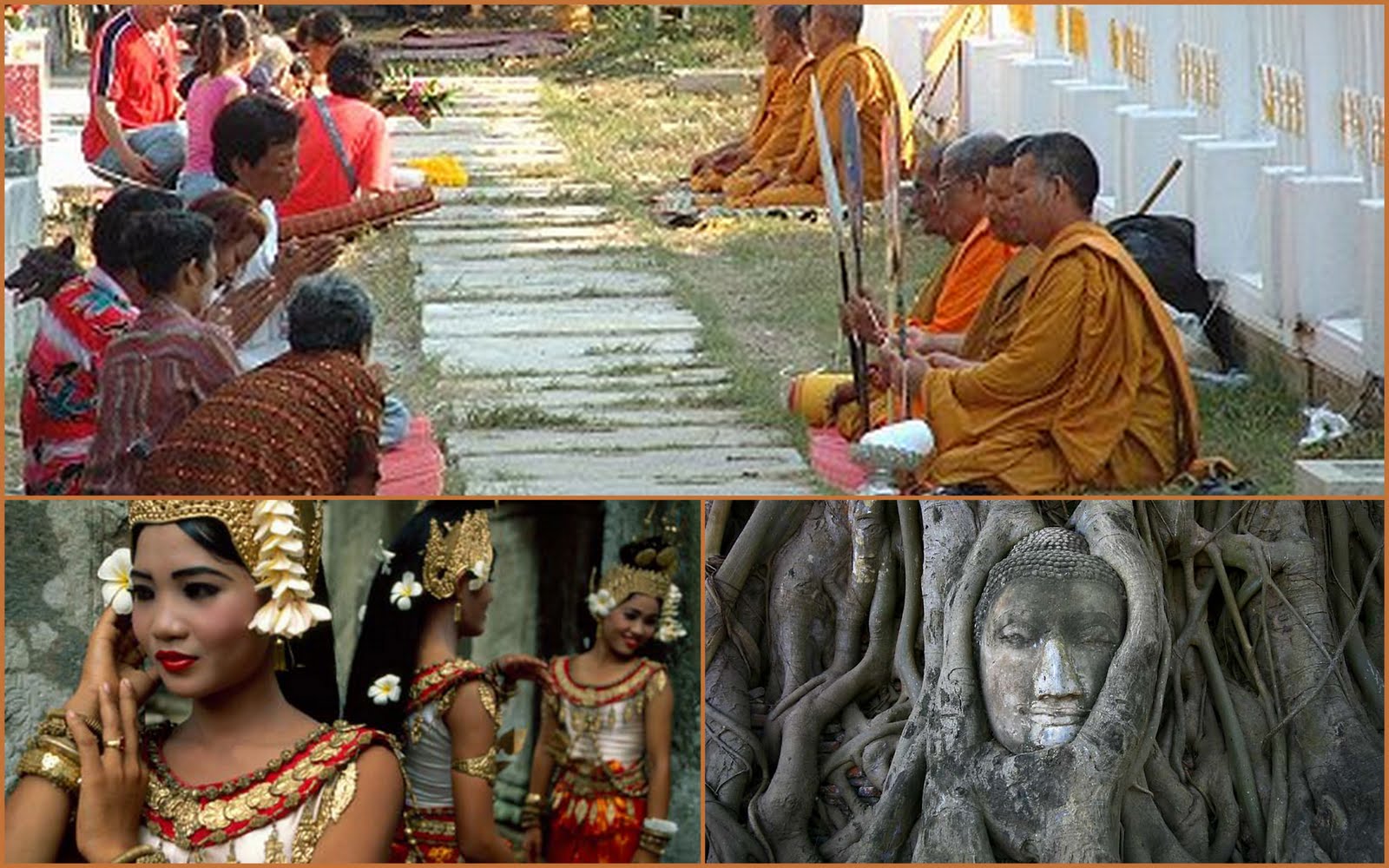
Songkran Festival is the traditional Thai New Year celebrated on April 13th. Families and friends gather to celebrate by visiting temples, sprinkling water on Buddha images in reverence, and sprinkling water on each other's hands as an act of wishing good luck.


In recent years, the tradition of sprinkling water has been interpreted by youngsters as a great excuse for a water fight, and it is not uncommon to have buckets and containers of water thrown at you by teams of merry makers in the backs of trucks as you make your way down the street - particularly in major tourist areas like Bangkok and Pattaya.

Children of all ages, and sometimes even adults delight in equipping themselves with water guns and spraying anyone who comes in their path - no one is exempt! Remember this date when you are in Patong and leave your cameras and anything likely to suffer water damage behind in your hotel room, because you will get wet. That happens to us when we went to Thailand for our first look-see trip and we arrived in Pattaya on Songkran. Wow! What an introduction was that to the Land of the Smiles!!


Songkran has traditionally been celebrated as the New Year for many centuries, and is believed to have been adapted from the Indian Holi festival. It is now observed nationwide, even in the far south. However, the most famous Songkran celebrations are still in the northern city of Chiang Mai, where it continues for six days and even longer. It has also become a party for foreigners and an additional reason for many to visit Thailand for immersion in another culture.

Such a fun festival, I wish I could go to Thailand now... We have a Thai temple here close by and we went on Sunday to celebrate, but the only thing we came across where very drunk Caucasians and their Thai wives spraying everybody wet, even when you had a camera around your neck... so after checking the whole festival out we left after 10 minutes. Even the food was not that great.... too bad! Now we have to wait for the big Thai festival that is held in August every year here in SA.

Have a great day! Tell me what are you doing today, celebrating Songkran??
Mireille

Tuesday, April 13, 2010

Songkran today in Thailand

I really love all the Thai festivals and after our first initial shock of getting a bucket of water dumped on us, or been shot at with a water pistol from hundreds of youngsters on Beach Road that first year, we knew later how to celebrate it in style!

If I would ask a Thai person to describe Songkran in one sentence it would be something like this:

Songkran is a long holiday to spend time being happy and excited with family and friends, respecting elders, going to the temple, playing with water, and eating seafood.


The Songkran Festival in Thailand (traditional Thai New Years) is the biggest and most sought after holiday on the Thai calendar. Songkran is usually thought of as a few inebriated day of throwing buckets of water and shooting water guns where everyone is a target.
It is traditional in temples all around the country to make merit by building sand pagodas. In Bangsaen the local people build both gigantic and beautiful sand pagodas.


The Songkran Festival in Thailand is not all about water splashing and having fun. Thai people also take time out to visit their local temples to make merit and also to pour rose scented water over the hands of their elders. They do this in order to receive a blessing and good luck for the new year. Some families also go to their local temple to pray and make merit for dead ancestors. The ashes of these ancestors are often contained in miniature "chedis" which are like upturned hand bells. Once finished, all of the family members will light joss sticks and then squat down to say a short prayer. The pagoda is then sprayed with scented water. Paper banknotes are later given to the temple as part of the merit making.

Traditionally, Thai people pour rose scented water over Buddha images and the hands of elders and monks. They do this in order to receive a blessing and also good luck for the new year.

Thai people also go to the temple to make merit by offering food to the monks and taking part in activities such as "chedi sai" where they build stupas out of sand.

The schools invites monks from a local temple so that the students and their parents could make merit.


One of the main events organized during Songkran celebrations around Thailand is the Miss Songkran Beauty Contest. The contest is a good way to view the most beautiful women in Thailand. However, don't go expecting a traditional Western type competition. The Thai girls are all dressed up in traditional clothes of this region and you won't find a swimming costume category at all. The winner of the contest will take pride of place during the Songkran Parade held in several bigger towns or cities.


One of the best Songkran Parades in Thailand is held in Phra Pradaeng District in Samut Prakan Province. It is traditional for the Mon people in this region to release birds and fish during Songkran in order to make merit for themselves. Many of the townspeople dress up in their best clothes and then parade through the town to Wat Proteket Chettharam.

One of the more traditional events that takes place during Songkran is "song nam phra". This is the practice of bathing Buddha images with rose scented water. Most tourists, and even some Thai teenagers, seem to think that Songkran is only about throwing water at each other. However, it was originally more a bathing of Buddha images and pouring water on the hands of monks and elders. The latter ceremony is called "rod nam dam hua". Over the years people tend to spend more time playing water fights which is obviously more fun.

I got all this information from a website from Richard Barrow, he has extensive info on Thailand about all different kind of subjects, check it out!

The only thing I am worried about for this years celebrations are the Red Shirts that are creating all this commotion and unrest in Bangkok! I believe there are already 17 dead people... I will find out some more info and write about that tomorrow!

But seeing all these images makes me miss Thailand so much, I am so happy that in less than 8 weeks I will be there for 2 months!! Can't wait!

Jasmine and Juliet are still too young to enter a beauty contest, but they would make a chance, no? What do you think?


Have a great day!
Mireille

Monday, April 12, 2010

Songkran ~ Thailand New Year's festival

We moved to Thailand in April 1999. We didn't have a house yet and my 40ft container with furniture hadn't arrived either, so the company put us in an hotel on Beach road in Pattaya where I would lay in the sun while Dirk was working. I would be searching for houses or condo's during the day, but that was all I had to do the first days. I didn't have a car yet, I didn't know the language, I didn't know anybody, and for sure I had no clue about the local customs.

So when we would go out at night that first week to eat dinner we had no clue what was going to happen to us... We thought: "Wow, it is really busy here on the streets!" And then the water throwing started!! We were surprised and soaked by the end of the evening. Hundreds of people on open trucks throwing water to tourists who had no clue, that is of course the most fun!! People who have no clue... like us!! This was our first introduction to the wonderful land of the Smiles!

This was also the last time I moved to a country without preparing and researching!!

But let me tell you a bit about how to celebrate Songkran in Thailand.

On the eve of Songkran Day, i.e. on the 12Th April, the people clean their house and burn all the refuse. This is a Spring Cleaning Day done as a duty in the belief that anything bad belonging to the old year will be unlucky to the owner if left and carried on to the coming New Year. It is something like a Public Health Cleaning Day but backed by traditional belief has proved more effective to emotional people than prosaic reason.


Early on the first day of Songkran, the 13Th April, the people both young and old in their new clothing go to the Wat or monastery belonging to their village or district to offer food to the monks there. A long table is erected in the compound of the Wat where monk's alms bowls stand in a row on either side of the table. Into the alms bowls the gathering people put boiled rice and into the covers of the alms bowls, food, fruits and sweetmeats. Such a performance can be seen at Wats outside Bangkok on Songkran Day. While the monks partake of their feast, music sometimes is played to celebrate the occasion.

In the afternoon of the same day there is bathing ceremony of the Buddha images and also of the abbot of the Wat. After this begins the well-known "water throwing feast". The bathing of images is done as ritualistic ceremony, but it is no other than a New Year's purification. Younger people will also on this day or the succeeding days go to pay their respect to and ask blessings from their elders and respected persons. They will pour scented water into the palms of the old people and present them with a towel and other bathing requisites. In the old days it was an actual bathing where the young people helped the old people to take a bath and to change their old clothing and put on the new clothes which the young people presented them as an act of respect to the aged on the occasion of the New Year.


Another duty to be done during the Songkran Festival is a religious service called Bangsakun performed in sacred memory to the dead. When a person died and was cremated, the ashes and charred bones of common people were buried at the root of a sacred fig-tree in a Wat. Such trees are to be found in the grounds of almost every Wat. It is a symbol of the Lord Buddha's enlightenment for under such a tree did Buddha sit in meditation and receive his enlightenment. If a person is able to erect a Pra Chedi or pagoda in the Wat the ashes and bones are then deposited in it. In later times a portion of the bones was sometimes kept in the house in a receptacle. On Songkran Day a religious service in sacred memory to the dead may be officiated by a monk or monks at the place where the ashes and the bones have been deposited, or as in some localities the people bring their dead bones to a village wat in company with others where a joint memorial service is performed. In some parts of the country the guardian spirits of the village and town receive also their annual offerings on Songkran Days. Obviously there are reminiscences or traces of ancestor and animistic worship in by-gone days.


So for people in Thailand, today cleaning day, tomorrow the fun begins: water throwing!! I am glad I am not a tourist in Thailand who has no clue!! LOL

If you celebrate Songkran ~ Have a wonderful celebration!
I just love all the Thai festivals!! Wish I could be there, since now I am prepared ;-)

Mireille

LinkWithin

Related Posts with Thumbnails